Cette formation en entreprise est proposée sur demande pour votre équipe, en ligne ou dans vos locaux, en anglais ou en arabe. Envoyez le formulaire ci-dessous et nous vous contacterons pour l'organiser. Demander cette formation
 FormateurAlaa Hady MBA, AI Engineer
Associé gérant, Advanced Management Solutions
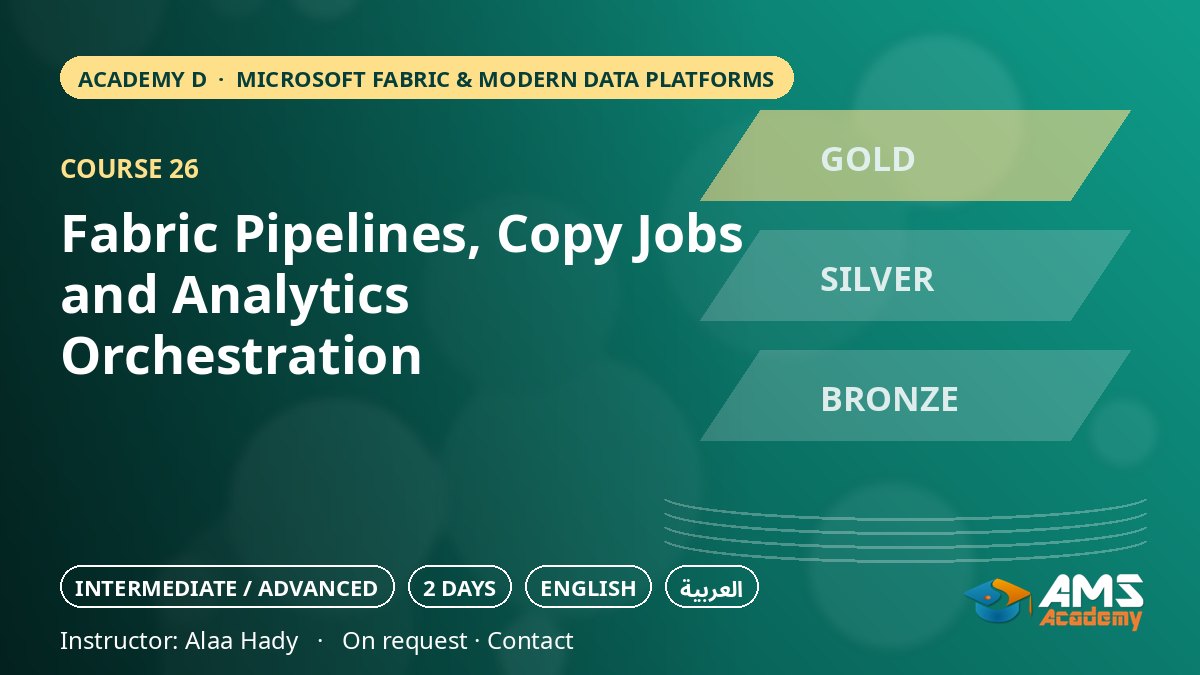
Instructor: Alaa Hady · Language: English or Arabic · Suggested duration: 2 days · Level: Intermediate to Advanced (Level 200–300)
Objectives
- Design metadata-driven, parameter-controlled orchestration pipelines in Fabric Data Factory.
- Ingest data from on-premises and cloud sources using Copy Activity, Fast Copy, and Copy Jobs (batch & incremental).
- Coordinate multi-step workflows across Dataflows, Notebooks, Stored Procedures, and Semantic Model refreshes.
- Implement production-grade error handling, retry policies, alerting, and CI/CD deployment.
Outline and contents
- Fabric Data Factory overview: Data Pipelines, Copy Job, Apache Airflow jobs, and On-Premises/VNet Data Gateways
- Building Metadata-Driven Pipelines: dynamic parameters, variables, expressions,
Lookup,ForEachloops,If Condition, andSwitchactivities - High-throughput ingestion patterns: Copy Activity optimization, Incremental Copy Jobs, and CDC (Change Data Capture) patterns
- Orchestrating heterogeneous workloads: chaining Dataflows Gen2, PySpark Notebooks, Warehouse T-SQL Stored Procedures, and Script activities
- Triggering Power BI / Fabric Semantic Model refreshes via the native Semantic Model Refresh activity (eliminating custom REST API hacks)
- Defensive pipeline engineering: activity dependency conditions (On Success, On Failure, On Completion, On Skip), retry logic, timeouts, and failure logging
- Automated notifications: integrating Office 365 Outlook and Microsoft Teams webhook alerts on pipeline failure or SLA breach
- Scheduling, storage event triggers, and Monitoring Hub diagnostics
- CI/CD portability: parameterizing workspace/item IDs and managing connections across Dev, Test, and Prod
- Hands-on Lab: Building a metadata-driven master orchestration pipeline that ingests 10 tables dynamically, runs transformations, refreshes the semantic model, and alerts Teams
Target audience
Data engineers, analytics engineers, ADF/SSIS developers migrating to Fabric, and BI platform teams.
Expected outcomes
Participants can replace fragile, hardcoded schedules with resilient, metadata-driven orchestration pipelines that manage the entire end-to-end data refresh lifecycle.
Demander cette formation
Parlez-nous de votre équipe et nous vous contacterons pour convenir des dates, de la langue, du format et du prix.