Cette formation en entreprise est proposée sur demande pour votre équipe, en ligne ou dans vos locaux, en anglais ou en arabe. Envoyez le formulaire ci-dessous et nous vous contacterons pour l'organiser. Demander cette formation
 FormateurAlaa Hady MBA, AI Engineer
Associé gérant, Advanced Management Solutions
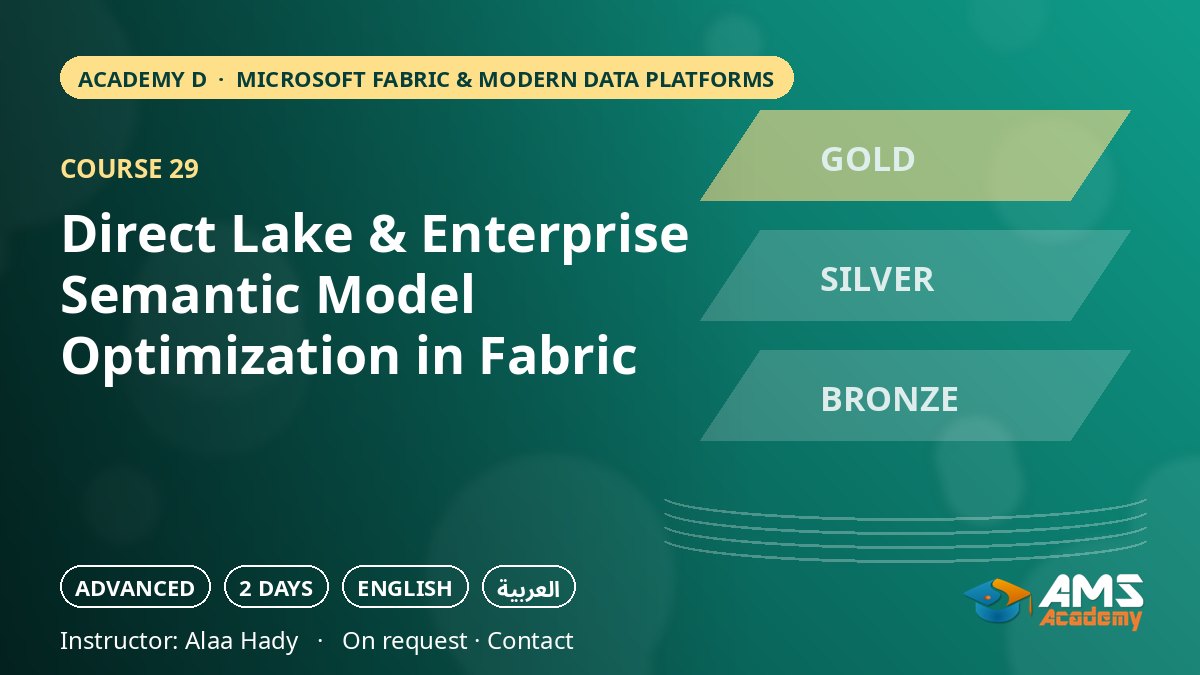
Instructor: Alaa Hady · Language: English or Arabic · Suggested duration: 2 days · Level: Advanced (Level 300)
Objectives
- Master the internal mechanics of Direct Lake mode (Direct Lake on OneLake vs. Direct Lake on SQL Endpoint) and how it bridges Import speed with real-time freshness.
- Control Delta table framing, V-Order compression, parquet row groups, and memory guardrails to prevent unexpected DirectQuery fallback.
- Use Semantic Link Labs and Tabular Editor 3 to automate model migration, Direct Lake readiness checks, and cold-cache warming.
- Architect hybrid Composite Models over OneLake for petabyte-scale datasets.
Outline and contents
- Storage Modes compared in the Fabric era: Import vs. DirectQuery vs. Dual vs. Direct Lake (on OneLake & on SQL Endpoint)
- Inside the Direct Lake engine: how VertiPaq transcoding loads Delta Parquet columns on-demand into memory without full dataset refresh
- Understanding Framing (syncing the semantic model to a specific Delta commit version) and triggering automated framing after ETL completion
- Preventing the DirectQuery Fallback trap: Fabric F-SKU guardrails (row limits, parquet file limits, memory limits, SQL views, calculated columns) and setting
DirectLakeBehavior - Optimizing Delta tables specifically for Direct Lake: V-Order,
OPTIMIZEbin-packing, controlling row group sizes, and sorting by low-cardinality columns - Migrating existing Import
.pbixmodels to Direct Lake using Semantic Link Labs (sempy_labs) - Pre-warming the Direct Lake memory cache after framing so the first executive user gets sub-second query speed
- Advanced DAX & Security considerations in Direct Lake (OneLake security vs. Semantic Model RLS)
- Hands-on Lab: Migrating a slow Import semantic model to Direct Lake, diagnosing fallback triggers, and automating framing + cache warming
Target audience
Analytics engineers, BI architects, senior Power BI developers, and Fabric performance specialists.
Expected outcomes
Participants can deploy ultra-fast Direct Lake semantic models over massive Lakehouses/Warehouses, eliminate multi-hour dataset refreshes, and guarantee zero unexpected DirectQuery fallbacks.
Demander cette formation
Parlez-nous de votre équipe et nous vous contacterons pour convenir des dates, de la langue, du format et du prix.