Este curso para empresas se imparte bajo petición para tu equipo, en línea o en tu empresa, en inglés o árabe. Envía el formulario y te contactaremos para organizarlo. Solicitar esta formación
 InstructorAlaa Hady MBA, AI Engineer
Socio director, Advanced Management Solutions
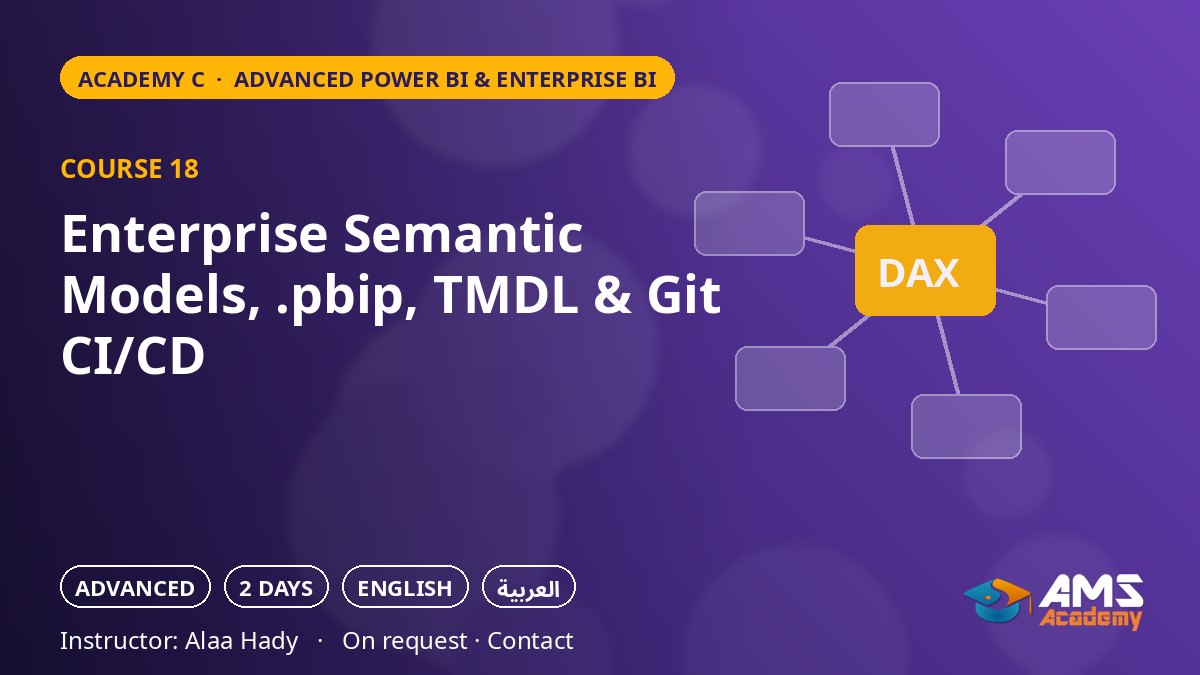
Instructor: Alaa Hady · Language: English or Arabic · Suggested duration: 2 days · Level: Advanced (Level 300)
Objectives
- Design centralized, "Golden" Enterprise Semantic Models that power dozens of thin reports and self-service users.
- Transition from binary
.pbixfiles to modern developer workflows using Power BI Project (.pbip), PBIR, and TMDL. - Implement version control, pull requests, and automated CI/CD pipelines using Git integration (Azure DevOps / GitHub) and Fabric Deployment Pipelines.
- Use external tools (Tabular Editor, ALM Toolkit) for enterprise team collaboration and schema diffs.
Outline and contents
- Enterprise BI architecture: Three-tier topology (Data Layer → Shared Semantic Model → Thin Reports)
- Designing for self-service discoverability: display folders, Perspectives, descriptions, synonyms, and Certified endorsements
- Modern Pro-Developer format: Power BI Project (
.pbip), Enhanced Report Format (PBIR), and Tabular Model Definition Language (TMDL) - Editing semantic models as code using TMDL View in Power BI Desktop and VS Code
- Version control workflows: Git integration in Fabric Workspaces, branching strategies, pull requests, and resolving merge conflicts
- Using External Tools safely: Tabular Editor (C# scripts & macros), ALM Toolkit for metadata comparison and selective deployment
- Enterprise Security at scale: Dynamic RLS, Object-Level Security (OLS), and workspace/dataset build permissions
- Automated CI/CD: Fabric Deployment Pipelines (Dev → Test → Prod), deployment rules, and REST API automation
- Semantic model auditing, documentation generation (
INFO.*DAX functions), and impact analysis before breaking changes - Hands-on DevOps Lab: Building a
.pbipsolution, committing TMDL changes to Git, and deploying across environments
Target audience
BI architects, analytics engineers, senior Power BI developers, and BI team leads.
Expected outcomes
Participants can establish true software-engineering discipline for Power BI—enabling multi-developer collaboration, code review, automated testing, and zero-downtime enterprise deployments.
Solicitar esta formación
Cuéntanos sobre tu equipo y te contactaremos para acordar las fechas, el idioma, la modalidad y el precio.