Diese Firmenschulung wird auf Anfrage für Ihr Team angeboten, online oder in Ihrem Unternehmen, auf Englisch oder Arabisch. Senden Sie das Formular unten und wir melden uns, um alles zu organisieren. Diese Schulung anfragen
 DozentAlaa Hady MBA, AI Engineer
Geschäftsführender Partner, Advanced Management Solutions
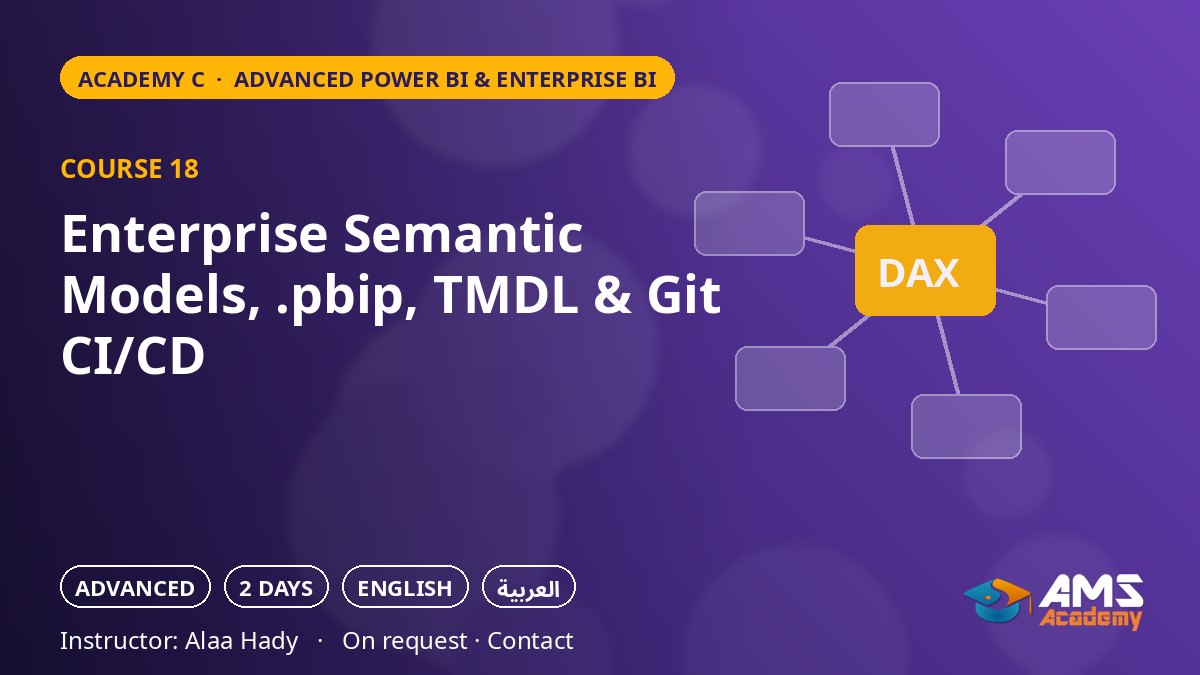
Instructor: Alaa Hady · Language: English or Arabic · Suggested duration: 2 days · Level: Advanced (Level 300)
Objectives
- Design centralized, "Golden" Enterprise Semantic Models that power dozens of thin reports and self-service users.
- Transition from binary
.pbixfiles to modern developer workflows using Power BI Project (.pbip), PBIR, and TMDL. - Implement version control, pull requests, and automated CI/CD pipelines using Git integration (Azure DevOps / GitHub) and Fabric Deployment Pipelines.
- Use external tools (Tabular Editor, ALM Toolkit) for enterprise team collaboration and schema diffs.
Outline and contents
- Enterprise BI architecture: Three-tier topology (Data Layer → Shared Semantic Model → Thin Reports)
- Designing for self-service discoverability: display folders, Perspectives, descriptions, synonyms, and Certified endorsements
- Modern Pro-Developer format: Power BI Project (
.pbip), Enhanced Report Format (PBIR), and Tabular Model Definition Language (TMDL) - Editing semantic models as code using TMDL View in Power BI Desktop and VS Code
- Version control workflows: Git integration in Fabric Workspaces, branching strategies, pull requests, and resolving merge conflicts
- Using External Tools safely: Tabular Editor (C# scripts & macros), ALM Toolkit for metadata comparison and selective deployment
- Enterprise Security at scale: Dynamic RLS, Object-Level Security (OLS), and workspace/dataset build permissions
- Automated CI/CD: Fabric Deployment Pipelines (Dev → Test → Prod), deployment rules, and REST API automation
- Semantic model auditing, documentation generation (
INFO.*DAX functions), and impact analysis before breaking changes - Hands-on DevOps Lab: Building a
.pbipsolution, committing TMDL changes to Git, and deploying across environments
Target audience
BI architects, analytics engineers, senior Power BI developers, and BI team leads.
Expected outcomes
Participants can establish true software-engineering discipline for Power BI—enabling multi-developer collaboration, code review, automated testing, and zero-downtime enterprise deployments.
Diese Schulung anfragen
Erzählen Sie uns von Ihrem Team und wir melden uns, um Termine, Sprache, Format und Preis abzustimmen.